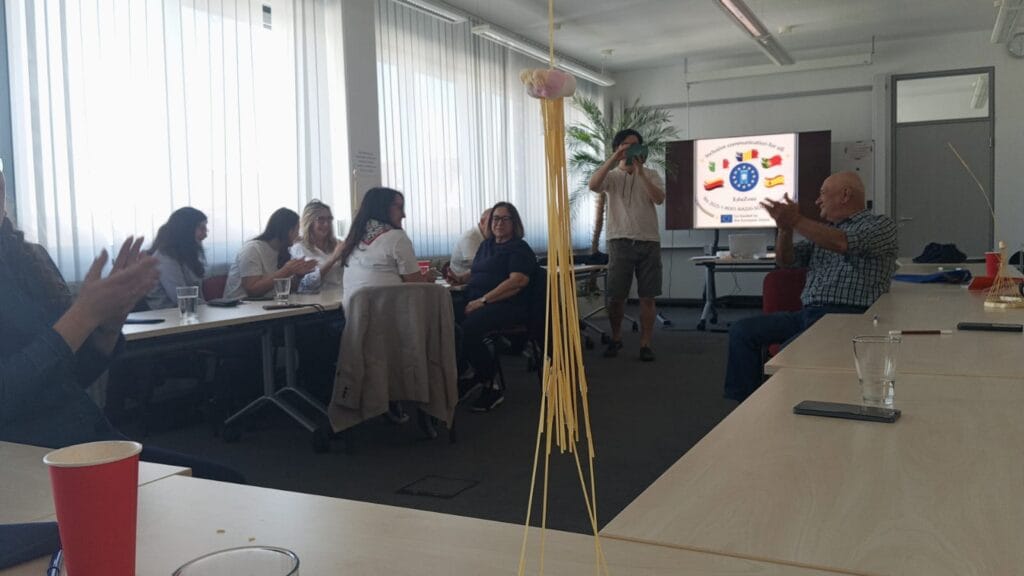
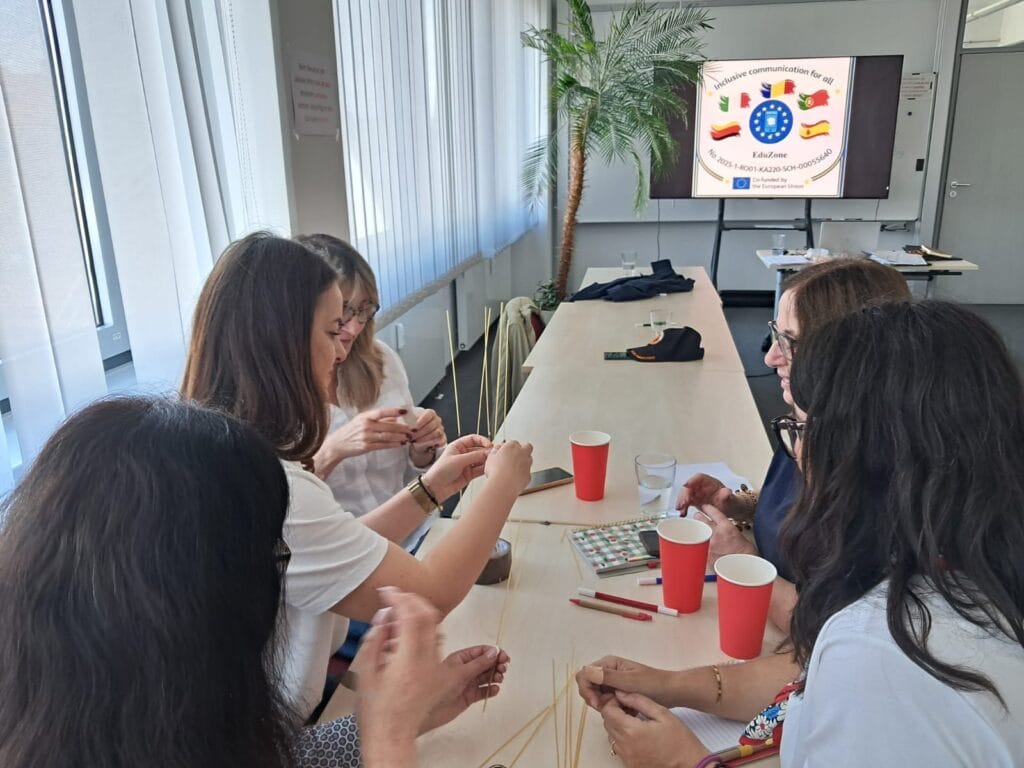
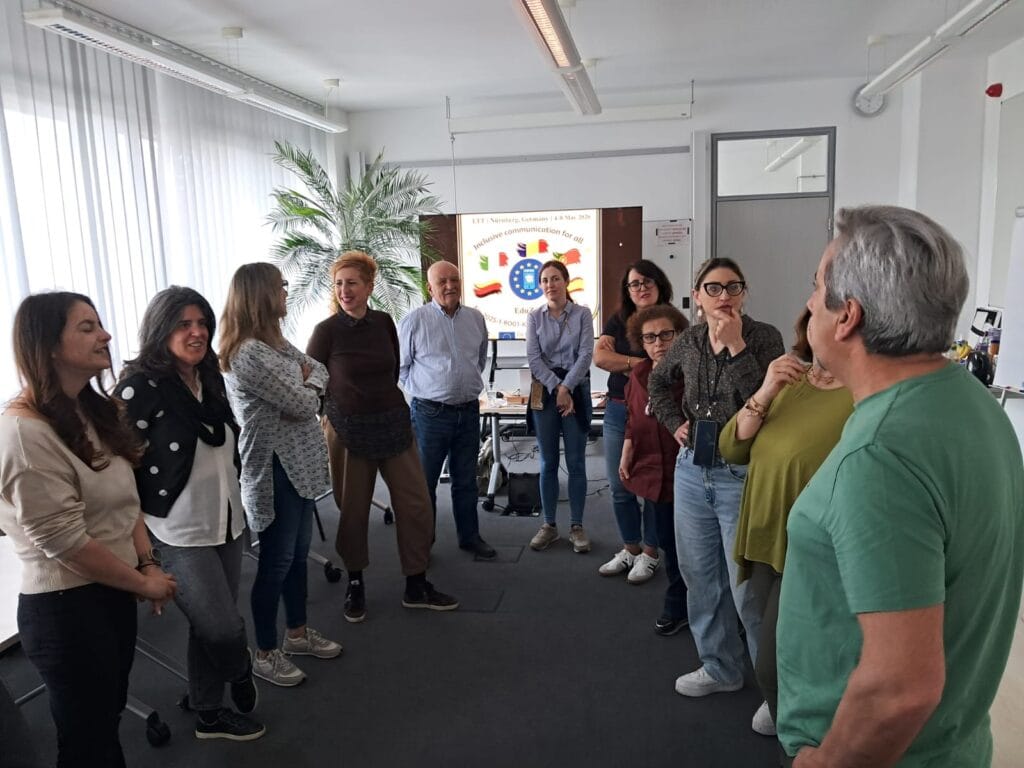
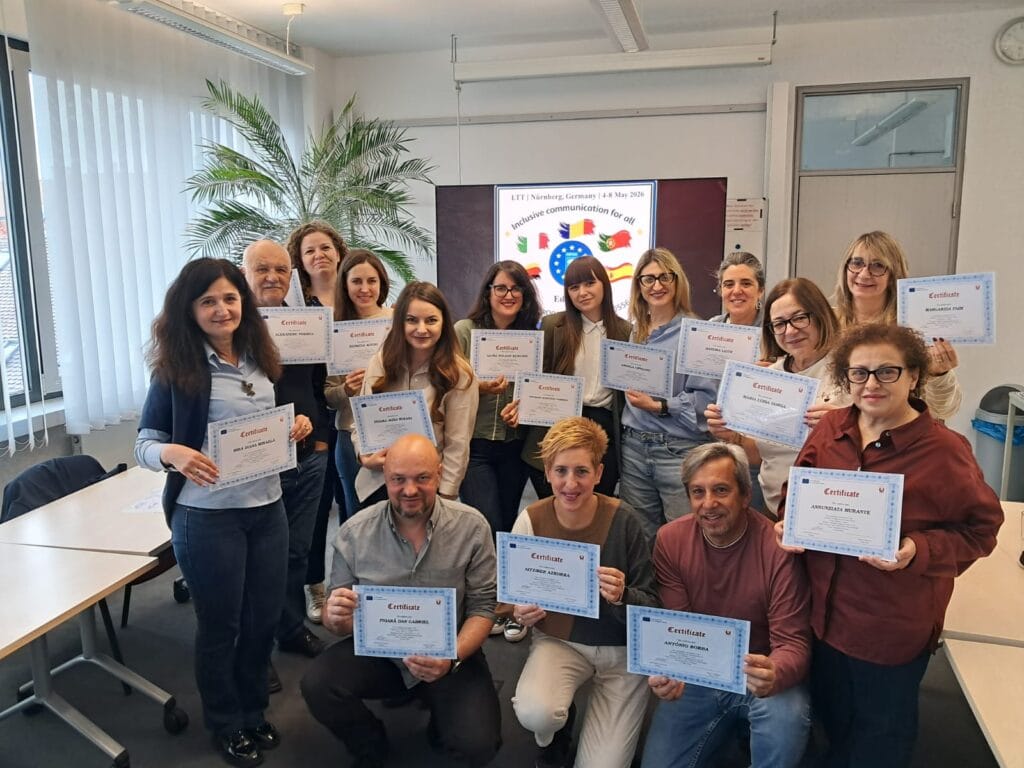
The Erasmus+ project “EduZone. Inclusive Communication for All”, reference number 2025-1-RO01-KA220-SCH-000353640, organized a five-day Training Course for Teachers in Nürnberg, Germany, between 4 and 8 May 2026. The 35-hour training brought together educators, specialists and project partners interested in strengthening inclusive communication practices in schools.
The course focused on Augmentative and Alternative Communication (AAC) and on practical ways to support learners who experience communication barriers. Each training day addressed a specific theme, gradually guiding participants from understanding the importance of AAC to planning its real-life implementation in educational settings.
Day 1 – Introduction to Inclusive Communication and AAC
The first day marked the official beginning of the Training Course for Teachers within the Erasmus+ project “EduZone. Inclusive Communication for All”. Participants were welcomed in Nürnberg and introduced to the objectives of the project, the structure of the training week and the expected learning outcomes.
The day focused on creating a safe, inclusive and participatory learning environment. Participants had the opportunity to get to know one another, share their professional backgrounds and discuss their expectations for the course. This first stage was important for building trust, encouraging cooperation and creating a positive group dynamic.
A central topic of the day was the importance of Augmentative and Alternative Communication in inclusive education. Participants reflected on the fact that communication is a basic human need and a fundamental condition for participation, learning and social inclusion. The discussions highlighted how AAC can support learners with different communication needs and how communication accessibility can help all students feel included and understood.
The training also emphasized the role of teachers, therapists and parents in implementing AAC successfully. Participants discussed how cooperation between school staff, specialists and families can help create learning environments where every child has the opportunity to express needs, choices, emotions and ideas.
Interactive activities, such as non-verbal communication exercises and group expectations mapping, encouraged participants to explore communication beyond spoken language. These activities helped them reflect on the challenges faced by learners who cannot rely only on speech and opened meaningful discussions about inclusion, accessibility and empathy.
Day 1 created a strong foundation for the following training sessions and introduced participants to the project’s mission: promoting inclusive communication for all learners.
Day 2 – Communication Barriers and Practical AAC Strategies
The second day of the training focused on understanding the communication needs of learners and identifying the barriers that may prevent them from participating fully in classroom life.
Participants explored different types of communication barriers, including barriers related to speech, language, cognition, sensory processing, emotional expression, social interaction and access to communication tools. The discussions helped teachers understand how these barriers can affect learning, confidence, participation and social inclusion.
A major part of the day was dedicated to practical AAC strategies. Participants analysed and practised methods such as modelling, prompting and reinforcement, learning how these strategies can help students express choices, needs, feelings, opinions and ideas. The training emphasized that AAC should encourage independence and active participation, not dependence.
The session also introduced different visual communication systems, including symbols, visual schedules, communication boards and structured classroom supports. Participants discussed how these tools can help learners understand routines, follow instructions, anticipate changes and communicate more effectively with teachers and peers.
Through group work and problem-solving activities, participants identified real-life classroom challenges and proposed inclusive solutions. Demonstrations and guided practice helped them understand how AAC strategies can be adapted to different learner profiles and educational contexts.
Day 2 provided participants with concrete tools and practical methods for supporting learners who face communication barriers, strengthening their confidence in applying AAC strategies in the classroom.
Day 3 – Using AAC Tools in Teaching and Learning Activities
The third day focused on the practical integration of AAC tools into daily teaching and learning activities. Participants explored how inclusive communication can become part of everyday classroom practice and not only a separate support measure.
Teachers reflected on how AAC can be used during different classroom moments, such as morning routines, transitions, group activities, individual tasks, storytelling, games, creative activities and feedback sessions. The discussions emphasized that learners should have opportunities to communicate throughout the entire school day, not only during specific support sessions.
Participants worked with examples of visual supports, communication boards, symbols and structured instructions, analysing how these tools can be adapted to different ages, subjects and learner needs. The training encouraged teachers to think about accessibility when preparing lessons, instructions and classroom materials.
A key focus of the day was inclusive lesson planning. Participants discussed how learning activities can be designed so that all students, including those with communication difficulties, can understand the task, participate actively, make choices and express ideas. The importance of clear instructions, visual structure, repetition and predictable routines was strongly emphasized.
The practical exercises allowed participants to design classroom activities using AAC strategies. Working in groups, they created examples of inclusive learning situations and discussed how these could be implemented in their own schools.
Day 3 helped participants move from theory to practice by showing how AAC can be naturally included in teaching methods, classroom organization and student interaction.
Day 4 – Collaboration, Case Analysis and Inclusive School Practices
The fourth day focused on cooperation and the development of inclusive practices at school level. Participants explored how AAC implementation can be strengthened when teachers, therapists, parents and school staff work together consistently.
The training emphasized that inclusive communication is a shared responsibility. Participants discussed the importance of regular communication between professionals and families, the exchange of observations and the need for common strategies to support learners in different environments.
Case analysis activities helped participants reflect on different learner profiles and communication needs. They discussed possible barriers, suitable AAC tools and practical support strategies. These exercises helped teachers connect the training content with real-life situations they may encounter in their schools.
Participants also explored how schools can create a culture of communication accessibility. Discussions focused on raising awareness among staff, classmates and families, encouraging acceptance of AAC tools and ensuring that communication support is used consistently in different school contexts.
Group activities gave participants the opportunity to exchange experiences, compare educational practices and propose solutions for improving inclusion in their own institutions. The peer-learning process was valuable because it allowed participants to learn from different perspectives and professional experiences.
Day 4 reinforced the idea that AAC is most effective when it is supported by teamwork, shared planning and a whole-school approach to inclusion.
Day 5 – Evaluation, Sustainability and Future Implementation
The final day of the Training Course for Teachers focused on the real-life application of AAC practices in schools and on ensuring the sustainability of the knowledge gained during the training week.
Participants explored practical implementation strategies for educational settings. They reflected on how AAC can be integrated into classroom routines, lesson activities, communication with students, cooperation with families and wider school inclusion policies.
A key part of the day was dedicated to monitoring and evaluation. Participants discussed the use of pre- and post-assessment methods to measure progress, identify learners’ needs and evaluate the impact of AAC strategies on participation, communication and confidence.
The training also introduced the importance of building a community of practice among teachers, therapists, parents and project partners. Participants discussed how continued collaboration, exchange of resources, peer support and shared reflection can help maintain and improve AAC practices after the training course.
Another important topic was sustainability. Participants reflected on how schools can continue using AAC tools and inclusive communication strategies beyond the project period by embedding them into teaching plans, school procedures, staff cooperation and family engagement.
Through guided planning, participants identified concrete ways to apply the knowledge gained during the course in their own educational contexts. The day concluded with reflection and discussion, allowing participants to review the learning journey, share key takeaways and define next steps for promoting communication accessibility in schools.
Day 5 successfully concluded the training week and reinforced the project’s mission to support inclusive communication for all learners.
Conclusion
The five-day Training Course for Teachers in Nürnberg was an important activity within the Erasmus+ project “EduZone. Inclusive Communication for All”. Through daily thematic sessions, practical activities, group work and reflection, participants developed a deeper understanding of AAC and its role in inclusive education.
The training strengthened teachers’ capacity to identify communication barriers, use visual and alternative communication tools, cooperate with families and specialists, and promote more inclusive school practices. By the end of the course, participants gained practical skills, useful resources and a stronger commitment to creating educational environments where every child has the right and opportunity to express themselves, participate actively and feel included.